In Maus by Art Speigalman Vladek has many different conflicts that he faces throughout the book. In this book Vladek and his wife go to many different ghettos and escape several before at the end they get sent to Auschwitz. He deals with his problems in many different ways and some of them are very interesting.
Most of the conflicts that Vladek faces are external conflicts. The main conflict at the beginning of the book is that his wife Anja is depressed. He solves this by going with her to a clinic so she can heal. I thin that this is a very good thing for him to have done. Another external problem was the ghettos and concentration camps. Whenever Anja and him were in danger of being sent to the ghettos they either ran or hid. He chose to run or hide rather than just go along with what the Nazis had planned for the jews which is what many people did. He didn't want him and Anja to go to the concentration camps. He wanted them to live free of the concentration camps and he took risks to make this happen. But when they tried to go to Hungary they were caught.
An internal conflict that Vladek goes through is that he does not like his second wife, Mala, at all. He thinks she only wants his money and he is always complaining about her. Instead of acting on this feeling he does nothing except pout about it and complain to Art. I think that he should have done something as soon as he realized he was unhappy. I wouldn't have done this at all. I would have went to a marriage councilor and if that didn't work out i would file for a divorce. He isn't taking matters into his own hands and he is unhappy.
Overall I think that Vladek handled his problems when he was with his first wife Anja much better than he does with his second wife. He handled his problems very well during the holocaust but after it he hasn't been doing very well.
Tuesday, March 27, 2012

Tuesday, March 6, 2012
To Kill a Human Being
In the book Seal Team Six by Howard E. Wasdin and Stephen Temple,Howard Wasdin shares many of his stories from his past career as one of the most advanced, highly trained fighters in the world. Howard was part of the U.S. Navy's most elite fighting force, the Navy SEALs (specifically the super elite anti-terrorism unit SEAL Team Six). In this book he shows just how hard it is to become a Navy Seal. There is an unbelievable amount of training involved to become one. In the portion of the book that I read today Howard Wasdin tells the reader about his first combat experiences in Iran and Iraq during Operation Desert Storm. The most interesting part of this section was when he explains how he felt after he had killed someone for the first time.
When most people think of a Navy SEAL they think of a killing machine who can kill one hundred of the enemy without skipping a beat. But in reality they are just like normal people, like me and you. They just have some of the most advanced combat training available to anyone on the face of the earth. Howard explained how hard it was mentally for him after he had killed for the first time. He says that the fact that he had made it so the enemy soldier can never breath again, see his family again, talk again, walk again, etc. really haunted him. He even asked his preacher if him killing someone in combat would send him to hell, the preacher said no because he honorably served his country. I think that it is so interesting that someone who is trained in so many different ways for the sole purpose of killing enemies of the U.S. would have such an emotional reaction to killing one. On the other hand I think that it makes perfect sense, Howard is only human. He has feelings just like you and me. Just because he went through BUD/S (really advanced training to become a navy seal) doesn't mean that he got transformed into a fighting and killing machine with no feelings what-so-ever.
I think that what could have contributed to Howard reacting to killing in combat for the first time is that also during Operation Desert Storm, Howard and a fellow SEAL captured 14 Iraqi soldiers. The soldiers immediately surrendered and continuously thanked the two SEALs for giving them a tiny amount of food and sparing their lives. At this moment Howard saw the enemy as human beings as opposed to "ragheads" (a derogatory term used during the Gulf War for Iraqi soldiers). I think that the fact that Howard had essentially failed at dehumanizing the enemy (which is a technique that is widely used by soldiers to make killing the enemy easier) made it much harder mentally for him to kill.
Wednesday, February 15, 2012
Long Term Marriage? **Spoiler Alert**
In Romeo and Juliet by William Shakespeare I think that it is very interesting that right after Romeo and Juliet are wed, Mercutio is killed, and ROmeo kills Tybalt. This further worsens the rivalry between the Montagues and Capulets. Then the Capulets demand that Romeo be put to death but the Prince only banishes him from Verona. I think that Romeo and Juliet are going to continue there love elsewhere if they can until the well known ending of the story.
I think that Romeo and Juliet will still love each other but they will do it elsewhere and stay married. Despite the fact that ROmeo killed Tybalt, Juliet's cousin, I think that they feel for each other to much so they won't get divorced. I think that they will try to stay married until their families go to war and they are too pressured upon to break the marriage off. Then the famous ending of this great tale will occur.
I think that the feeling that Romeo and Juliet have of being married but feeling that they do not have their family's full support is felt often by married people in today's world. While most people getting married are not from enemy families, sometimes the husband isn't the wife's parents first choice for her to marry or vice versa. But in Romeo and Juliet's case they have much more pressure and despite that they still get married.
Tuesday, February 7, 2012
Teens Crashing Parties (est. The 1500's)
In the brilliant work of playwriting Romeo and Juliet by William Shakespeare I found similarities between 1500's Italy and today, the 21st century. One of these similarities is the in Act 1 Scene 2 Romeo and Benvolio trick a capulet servant and decide to crash a Capulet party even though they are Montagues the sworn enemies of the Capulets. The objective of this party crashing: pick up a new chick for Romeo who is depressed because the one that he loves doesn't second that feeling. I think that this is so interesting because now more than 500 years later teenage boys do the same thing sometimes for that very reason.
I found it very interesting that essentially the basics of the teenage boys mischievous ways has stayed similar over the course of 500+ years. While horse drawn buggies have long been replaced by cars and swords and shields replaced by guns and tanks, teenage boys still enjoy crashing parties. People may think that we have changed so much since the 16th century and in some ways we have, but in others such as the mischievous ways of teenagers and hate, which is mention in the later paragraph, we haven't changed all that much.
Also another thing that remained similar after 500+ years is that there are still many family rivalries such as the on that takes place between the Montagues and the Capulets. For example between mafia's. Sadly hate is still a very big part of our society today, maybe even more so than back in the times during which the brilliant William Shakespeare wrote this masterpiece of playwriting.
This shows us how actually we aren't so unalike our ancestors in the 1500's. People may think that they have changed so much like for example lost tons of weight, but they may realize that they still find themselves longing sugary foods etc. Even while the things that we say, use, hear etc. change we have to remember that we really aren't so different than people long ago.
Tuesday, January 31, 2012
When the FBI gets outgunned by two thugs, something has to be done
I recently finished the book Glock: The Rise of America's Gun by Paul M. Barrett. I thought that it was very interesting that instead of using the textbook non-fiction introduction Barrett opened up his book with a story that introduces the problem that the Glock (main topic of the book) solved. The story which takes place on April 11, 1986 in Miami, Florida is about two armed bank robbers who were being chased by eight FBI agents. When the bank robbers were cornered they opened fire on the agents. The thugs had a shotgun and a hunting rifle. The FBI agents had mainly revolvers and a few (3) semiautomatic pistols. The thugs were eventually killed but at a great cost. Two agents died, 3 were permanently wounded, and 2 were wounded. The FBI had been outgunned by two thugs. Something had to be done.
I think that it is unbelievable that something like this could happen. How could the most highly trained non-miitary agency in the U.S. be outgunned by two thugs? Especially with weapons that anyone over 18 in the U.S could get with a proper license I can't believe that this wasn't a bigger story than it already was. Two civilians with some training outgunned eight highly trained FBI agents. Could you imagine what would have happened if it had been normal police officers without the intense training that the FBI agents have to go though. I am surprised that a gun like the Glock wasn't being used by every U.S. Policeman, especially a unit like the FBI. These revolvers just weren't good enough, they were relics, not useful weapons. Revolvers like this were in use in the late 1800's which is around 100 years before this incident. In 1986 U.S. soldiers weren't going to battle with single shot rifles. So why are the elite police or the FBI going to take down heavily armed bank robbers with revolvers?
I think that including this story as an introduction to the book was ingenious on Barrett's part. This incredibly gripping and intriguing story really made me want to read this book. Instead of the normal textbook introduction to a nonfiction book that turns many readers away due to its dullness. This lead is really interesting. In the world today I think that if more non-fiction books had interesting beginnings lie this one, than more kids would read non-fictiong for fun. Boring leads and just plain boring nonfiction books are what turn us away from nonfiction. If this book had started off with: The Glock semiautomatic pistol was invented by Gaston Glock in Vienna, Austria, and it was a major breakthrough in the firearms industry. I wouldn't be reading this book. But instead it starts off: "It was nine forty-five a.m. on April 11, 1986, when Special Agents Benjamin Grogan and Gerald Dove spotted the two suspects driving a stoled black Chevrolet Monte Carlo on South Dixie Highway." That is an intriguing first line. It is definitely not your average opening for a nonfiction book. But its definitely suitable because the Glock is not your average gun.
Tuesday, January 24, 2012
Reading Art
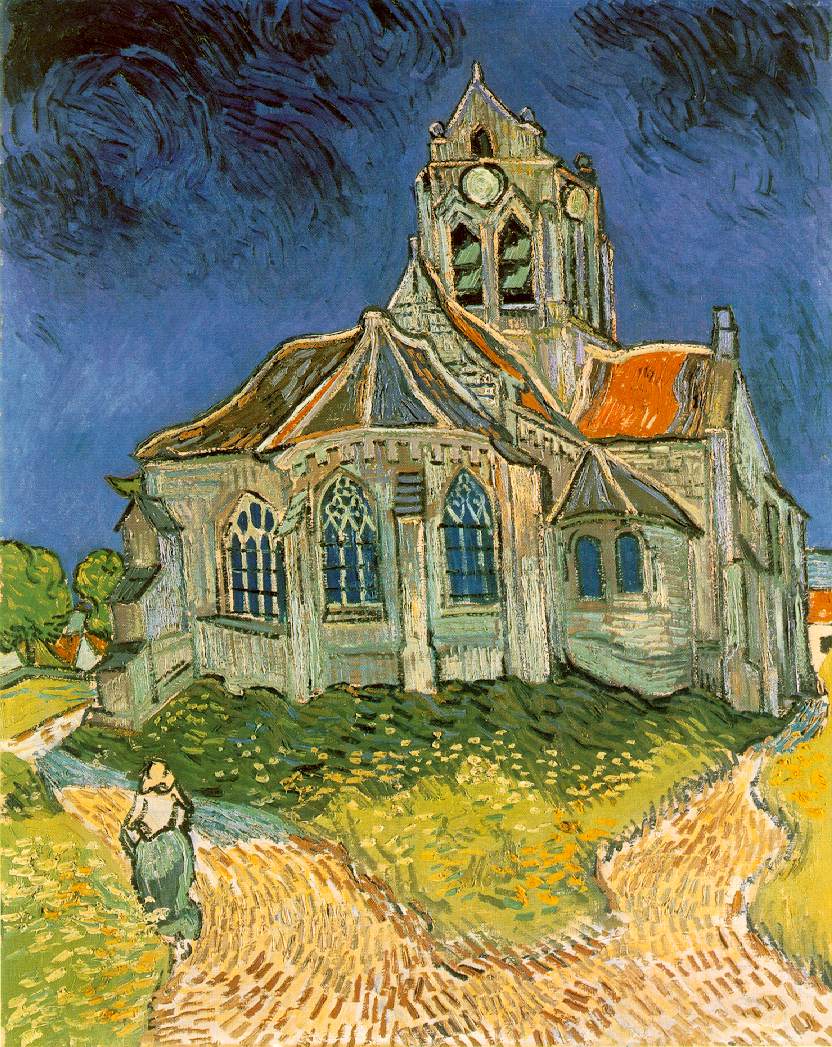
I chose a work by famous painter, Vincent Van Gogh, called Church At Auver. I think that Van Gogh purposefully made this painting have a gloomy, freaky look. I think that it is interesting how the bottom half of the painting is very cheery, but the top is gloomy. I also think that Van Gogh meant to split the mood of this painting like this. It almost seems that it is daytime at the bottom of the painting that has the grass and the top looks like it is night.
On the top of the painting the sky is blue but in the top left and top right corners there are black claw-like shapes. This adds to the scary/gloomy look of the painting. I also think that the unique brush strokes that are Van Gogh's trademark add to this look as well on the church. Also the colors on the bottom of the picture give are bright with very green grass and trees. But of the top of the painting the sky is dark navy blue and black like it is night time. I think that it is odd that it seems to have two times of day. Also if you look closely and zoom to the picture there seems to be a green/gray figure in the center window of the church, this also adds to the gloomy/scary affect of the picture.
I connect to this work because I think that it is common for many things in life to give off different moods. Sometimes I feel happy about something but then also nervous. I think that nearly everything gives of more the one emotion whether good or bad. I think that Van Gogh tried to get the viewers of this painting to feel emotions and wonder about it. I think that this is true of anyone who creates a piece of art/literature/etc. wants to make people think about and wonder not just look at or read their work.
Tuesday, January 17, 2012
Class Blog Post All Star Mentor
I think that our class blog post all star mentor should be Micah for her post on The 33 Strategies of War by Robert Greene(http://ihaveawhitevan.blogspot.com/2012/01/33-strategies-of-war-by-robert-greene.html). In this post she really goes above and beyond the expectations of an average blog post. For one her post is very long(four lengthy paragraphs), but it isn't just long it is also interesting and engaging. Also I. thought that it is very interesting that instead of writing about something in the book she chose to write about the book in general and about the morality of the book and the author in general. Overall this is a great blog post for many reasons and should be the class mentor blog post
Subscribe to:
Posts (Atom)